Independent build
Keepford: calls answered, and a clear next step for your team.
An AI phone receptionist that answers, books a time or takes details, and transfers urgent calls. Every call is stored with an outcome. Prayantr's own build, demonstrated on a demo line that answers as a fictional plumbing company. Not yet in use by a business.
Pauses are shortened; nothing is re-voiced or reordered.
What you are hearing
Two real calls to the demo line.
A caller books a visit for a blocked drain. Then a second caller reports a burst pipe and is transferred. Use the player at the top of the page; the times below match it.
Independent build Real calls to a demo line Operator preview with sample data
Call 1: a routine booking
- 0:00The assistant answers, says it is an AI and that the call is recorded
- 0:08The caller asks to book a visit for a blocked kitchen drain
- 0:13Postal code taken and checked against the service area
- 0:34Three open times offered from the schedule
- 0:44Name and callback number taken and read back
- 1:09Appointment booked and confirmed to the caller
Call 2: an urgent call
- 1:17Second call answered
- 1:25The caller reports a burst pipe
- 1:30Shut-off guidance is read, then the caller is told they are being connected
- 1:43The on-call line rings and answers (an automated test line)
After the call
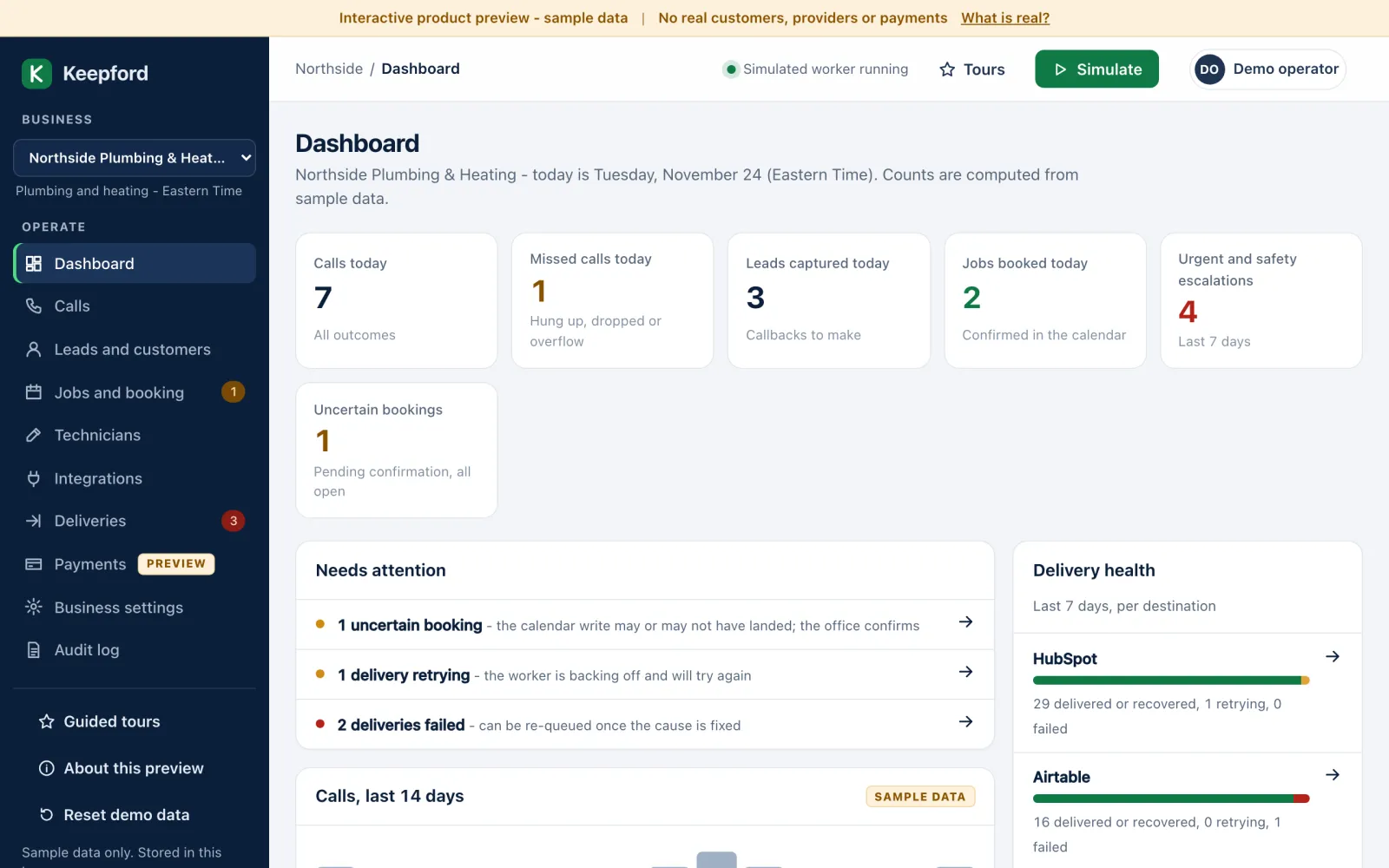
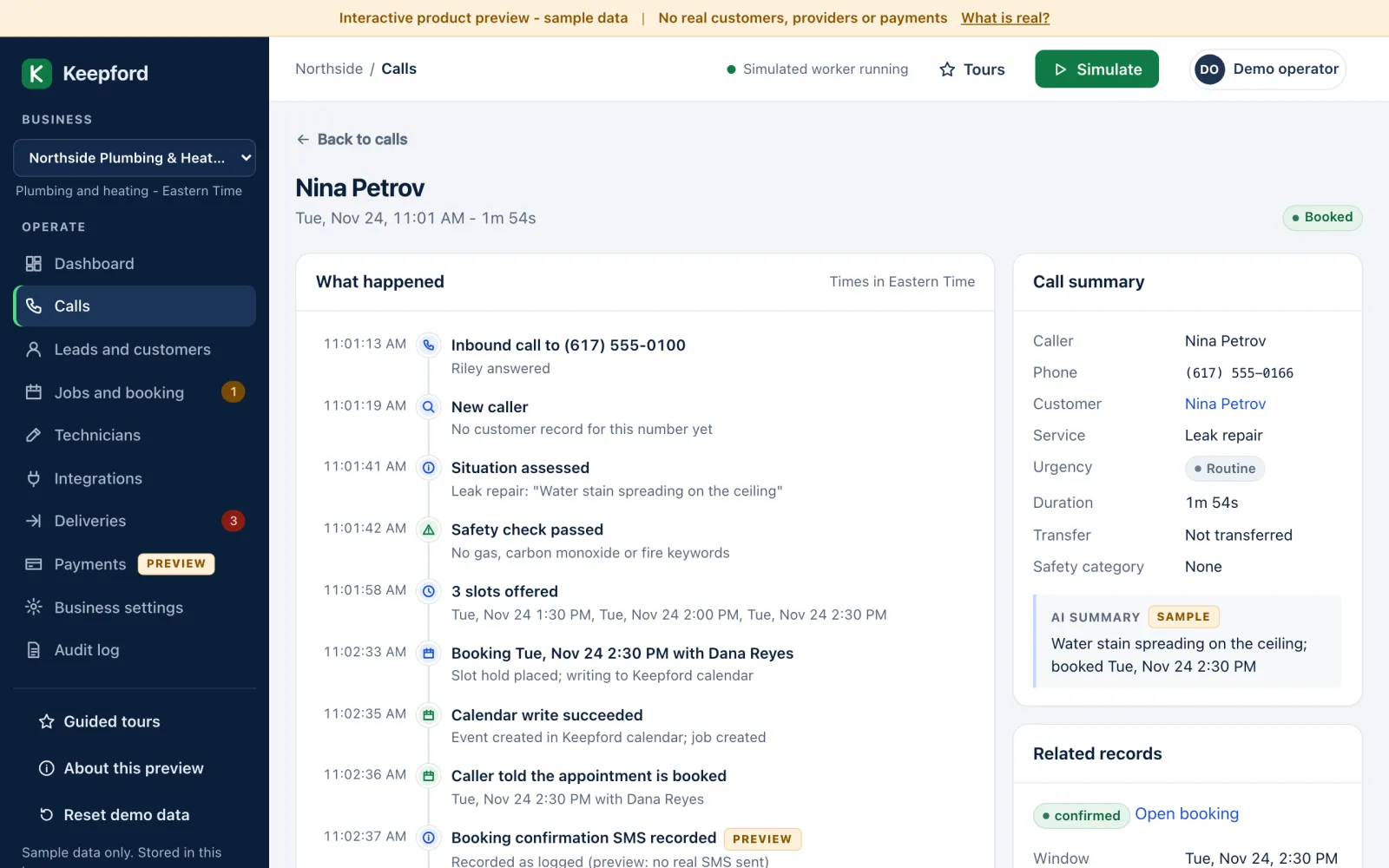
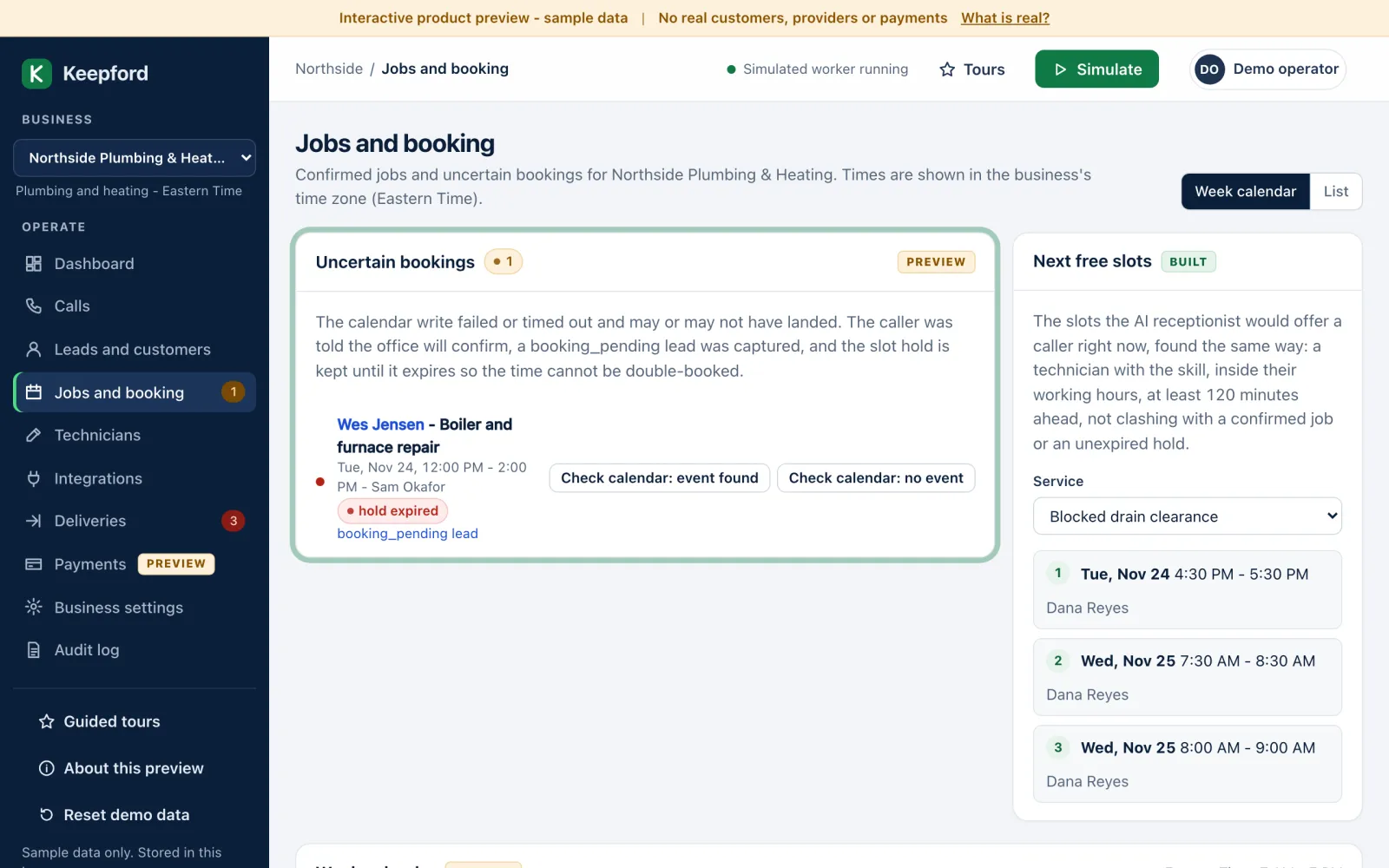
What the operator sees, in a preview you can open.
The operator preview shows how calls, bookings and anything that needs attention look from the office. It uses fictional sample data, runs entirely in your browser and is not connected to the phone service.
An example journey
From the call to the next action.
Steps 1 to 4 were demonstrated on real calls to the demo line. Step 5 is shown in the operator preview, which is simulated.
The call is answered
The assistant says it is an AI and that the call is recorded, then asks what is going on.
Details are captured and checked
What the caller needs, where they are and how urgent it is, checked against the services and area the business has set.
A time is booked, or details are taken
Only times that are actually open are offered, and the caller hears "booked" only after the booking has been saved. If no time suits, or the caller is out of area, their details are taken for a callback.
Urgent calls go to a person
The caller hears the business's guidance and is transferred through the phone system. If nobody answers, they are told plainly what happens next and can leave a voicemail.
The office reviews what happened
Each call has an outcome: booked, lead captured, transferred, missed. Bookings that could not be confirmed and updates that failed to reach another tool are listed separately, so they are not mistaken for successes. Shown in the operator preview (simulated)
Every call and its outcome are stored by the real service. The office screens shown above are a preview of the operator console; that console is built but not yet deployed.
Where it stands
Demonstrated, built, and not yet available.
| Part | Where it stands |
|---|---|
| Answering, capturing details, booking into its own calendar, urgent transfer, voicemail | Demonstrated on real test calls to the demo line (September 2026, one tester, fictional business) |
| Safety script for gas and carbon monoxide reports | One real test call each: the approved script was spoken and the call ended. Fire is built but untested on a call. Not a safety guarantee, and not an emergency service |
| Operator console | Built, not deployed. The public preview is a browser-only simulation with sample data |
| Sending updates to n8n and Odoo | Tested against the real software running locally. Not run on a hosted or customer account |
| Sending updates to CRMs, spreadsheets, Slack, email and accounting tools | Code with automated tests against simulated responses only. Not connected to real accounts, so not listed as supported |
| Text messages and owner alerts | Generated and stored, never sent. Texting would need its own registration |
| Automatic follow-up on missed calls | Not built. Each call is stored with its outcome for a person to act on |
| Use by a business | None yet. There are no customers or results to show |
Is it only for plumbers?
No, but the demonstration is. The demo line is set up as a plumbing and heating company because trades calls show the hard cases: urgent jobs, service areas and booking. The hours, services, questions and transfer rules are configured for each business. Whether it suits another kind of business depends on its calls and workflow, which we assess individually before quoting.
How it is built
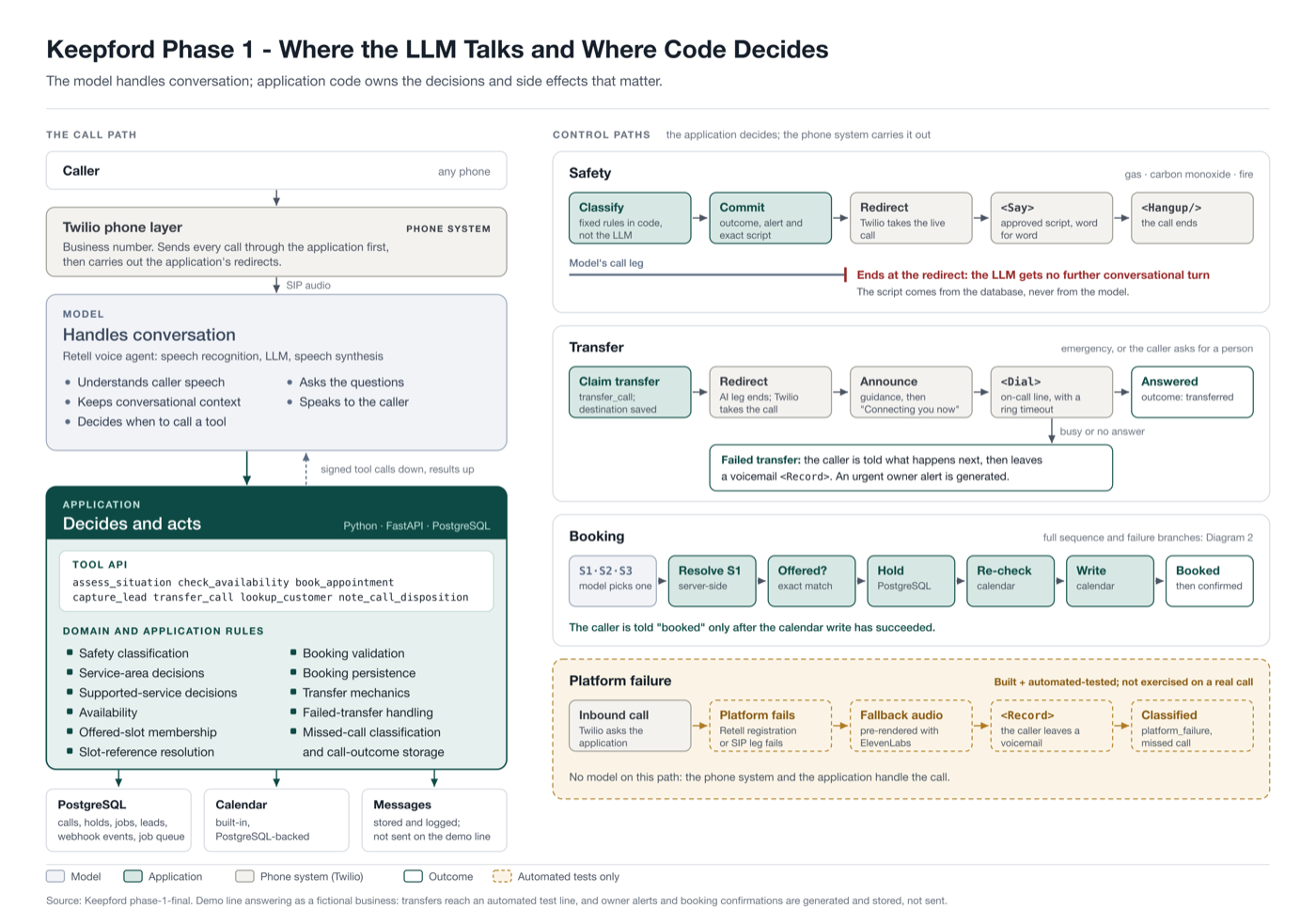
The model holds the conversation. Code runs the checks that matter.
Application-controlled checks
Every call reaches the application first. Service area, availability and safety keywords are checked by code, not left to the voice model.
Booking integrity
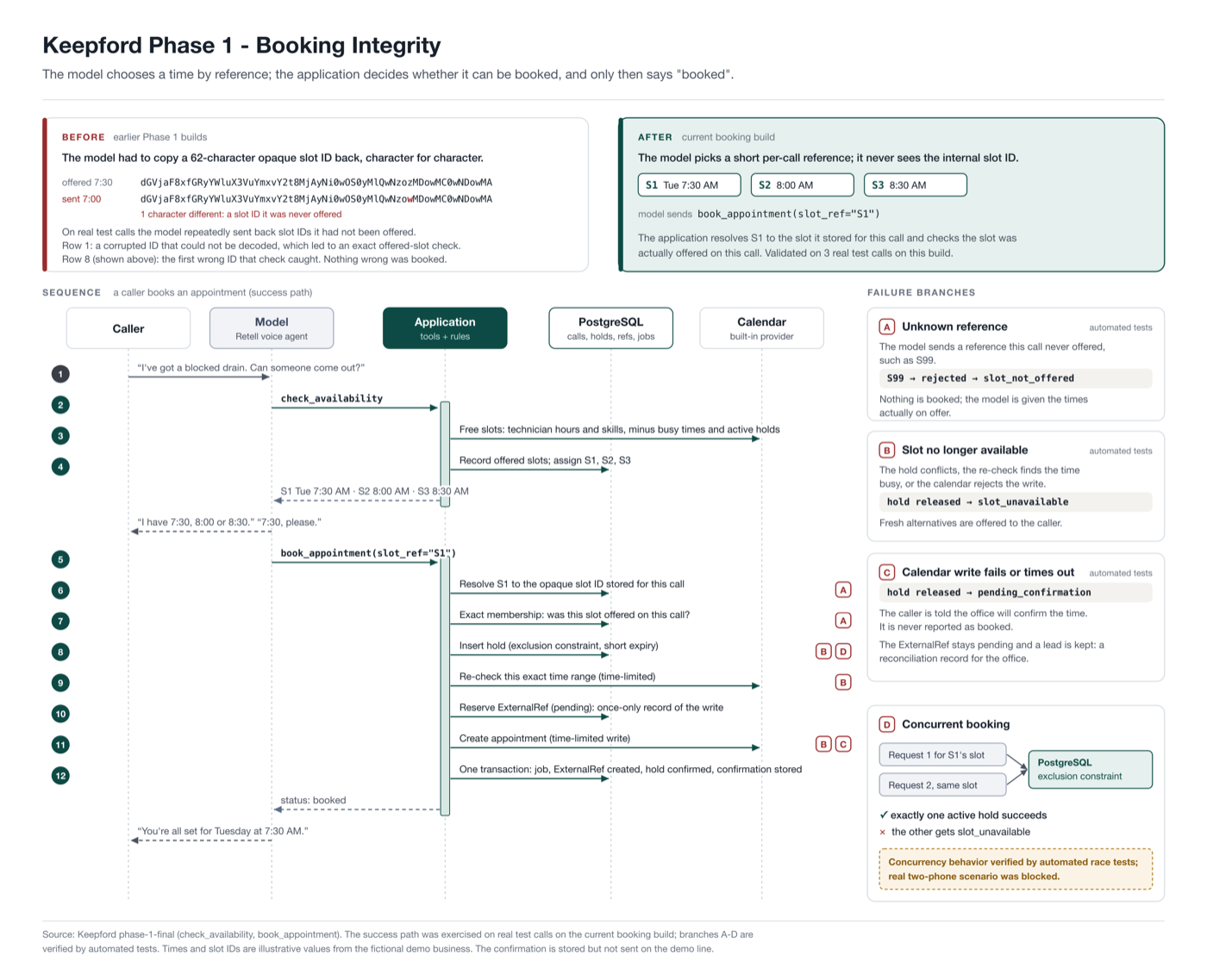
The model picks a short per-call reference, never an internal identifier. The application confirms that time was offered on this call, holds the slot and only then says it is booked.
Transfers through the phone system
Urgent calls and requests for a person are transferred by the application, with a clear message and voicemail if nobody answers.
This is not a claim that the model cannot make mistakes. It still chooses when to call a tool. The split is narrower: once a request reaches the application, code performs the checks, the booking write and the transfer.
Call control diagram
Booking sequence and its failure branches
Test evidence: what was checked, and its limits
| Claim | How it was checked | Limit |
|---|---|---|
| Booking and handoff flows work on a phone line | Real phone calls to the live demo line in September 2026: of 23 acceptance scenarios, 20 passed and 3 could not be run | One tester, calling from a non-US phone. Earlier failed attempts were recorded and fixed. Not tested by customers |
| Gas and carbon monoxide test calls: scripted response, then call ended | One gas and one carbon monoxide real test call in which the approved script was spoken and the call ended. The design moved script delivery and hang-up from the model into the phone system after two earlier failed attempts | Observed in the tested calls only, not a safety guarantee. Detection is keyword-based and can miss unusual phrasing or dropped words. Fire is implemented but was not tested on a real call |
| Only offered times can be booked | Per-call references, introduced after real calls showed the model mis-copying identifiers; passed on real calls | Small number of calls |
| No double booking | Database constraint plus automated race tests with simultaneous requests for one slot | Not tested with real simultaneous callers |
| Failure paths (write fails, retries, webhooks) | Automated tests | Not all exercised on real calls |
Response time was measured on 39 of those real calls: a median of about 1.1 seconds from the caller stopping to the agent speaking, one tester and a point-in-time reading.
Built with Python, FastAPI and PostgreSQL on a voice platform and a phone network; development was AI-assisted under the principal's direction and review. The longer case study is on amitsolanki.com, and the demo's own site is keepford.com.
Want calls answered like this for your business?
Tell us roughly how many calls you get, what callers usually want and who should take urgent ones. We assess the fit and quote for your setup. The AI phone receptionist is also on the current offers page.