PrayantrOpen-source implementation
Service
Open-source software, installed, extended and handed over.
Prayantr sets up, customises and connects open-source business software on accounts you own, starting with Spree for commerce and Chatwoot for customer conversations, and leaves you able to run it.
When open source fits
You want software you control, without building it from nothing.
Some systems sit so close to how a business works that renting them stops making sense: the store you sell through, the inbox your customers write to. Open-source platforms let you own the data and the code, and change what the vendor's cloud product will not.
Owning it also means running it. Someone has to host it, apply updates, keep backups that actually restore and fix what breaks after a release. Self-hosting trades a licence or subscription fee for hosting and operator time, so whether it costs less than the vendor's cloud depends on your volume, your staff and the features you need. We will tell you if a hosted product is the better buy.
What we do
From choosing the platform to handing you the keys.
Selection and fit
We check the platform against the work it must do, which edition that needs and what the vendor charges for. If a feature you need sits in a paid edition, you hear that before any quote.
Deployment
One agreed install on hosting and vendor accounts in your name: TLS, email and background jobs where the platform uses them, and backups with one restore verified into a separate target.
Customization
Changes built as extensions, plugins or a separate service wherever the platform allows it, so the core stays upgradable instead of quietly forked.
Integrations
Connections to the systems you already use, with explicit acceptance criteria and the failure cases written down: timeouts, duplicate deliveries and invalid payloads.
Upgrades
A written upgrade procedure for the install we hand over. Moving an existing install across versions starts with an assessment of your customisations.
Handover
Admin access and accounts held by your named owner, a handover note and a walkthrough with whoever will run it. Optional maintenance is agreed separately.
Platforms we work with
Two platforms, chosen because we have work to show on them.
Commerce
Spree Commerce
An open-source commerce platform on Ruby on Rails. Store setup, custom workflows, extensions and integrations, with Platestead, our own ordering platform, as the evidence.
Customer conversations
Chatwoot
An open-source shared inbox for customer conversations. Setup, inbox and workflow configuration, integrations and handoff troubleshooting, backed by a failure lab we built.
We are not starting with a long list of logos. If your platform is not one of these two, describe it anyway and we will say plainly whether we are the right people for it.
What has been shown
Our own builds, and where they stop.
Independent builds No client deployments
Everything we can point to was built and run by us, on our own demonstration data. None of it is a client's live system.
| Step | Spree | Chatwoot |
|---|---|---|
| Installed and running | Platestead, our own platform, runs on Spree 5.6 in demonstration deployments. | A lab install of Community Edition v4.19.0 with Docker, built for testing. |
| Customised | Four published extensions and private ones, built outside Spree's core. | A small Rails bot connected through Chatwoot's own interfaces. |
| Connected to other systems | Sandbox accounts only: Stripe test mode, Square and Clover sandboxes, Uber Direct and DoorDash sandboxes. | Signed, deduplicated webhooks between Chatwoot and the lab bot. |
| Backup restored | Not shown. | Not shown. |
| Upgraded to a newer version | Not done. Platestead has not moved to Spree 6. | Not done. The lab has not been moved from v4.19.0. |
Backups and restores are part of what a launch includes, and we check one restore for you then; they are not something we can point to as past work. Read more on Spree and Chatwoot.
Open source we build
Libraries and extensions, published for anyone to read.
These are small, focused packages that you add to your own application. They are not platforms you deploy on their own, and each label says how far it has been tested.
Published, MIT Unofficial
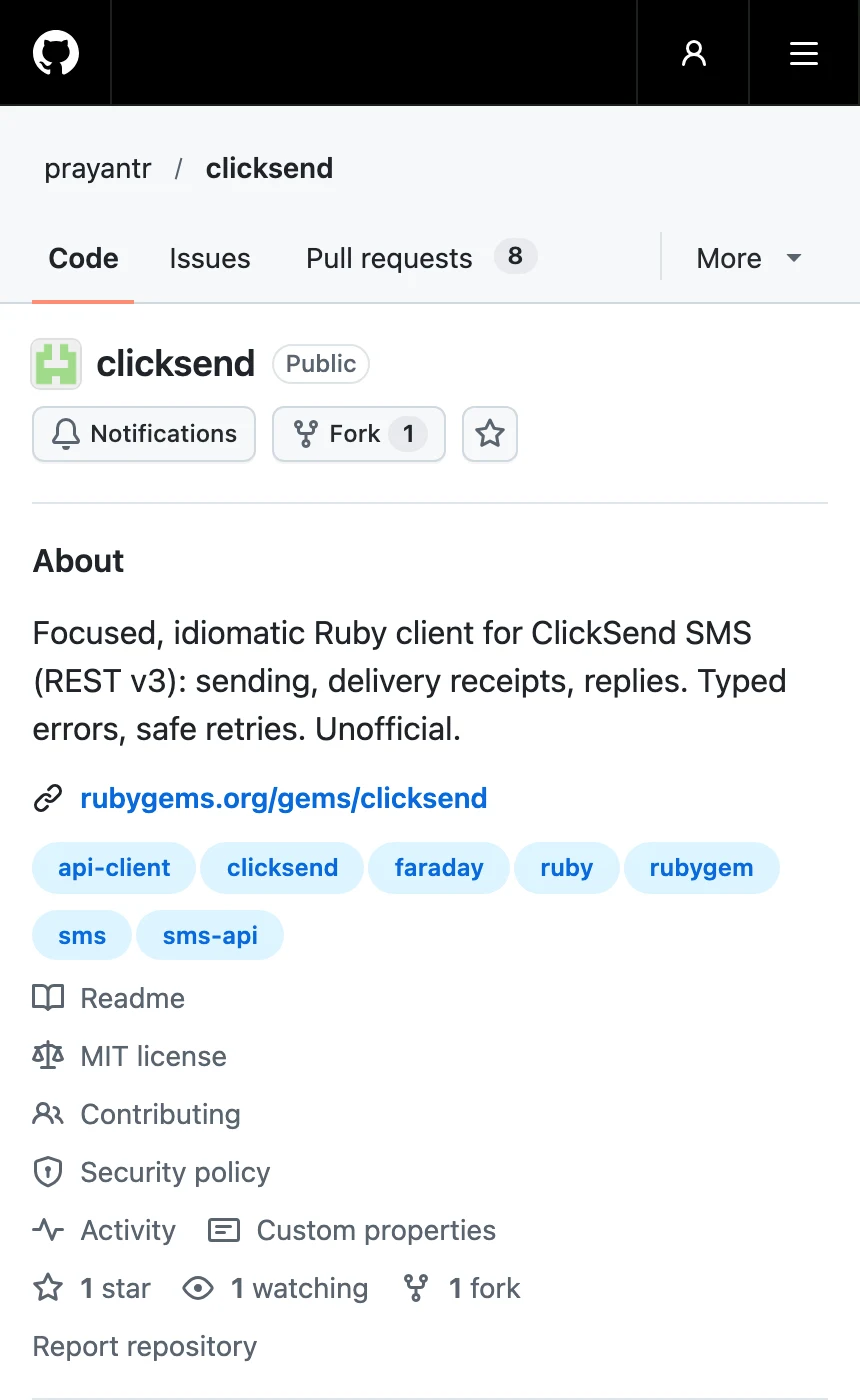
clicksend
An unofficial, open-source Ruby client for ClickSend's SMS API. It is not affiliated with ClickSend. When it cannot tell whether a message was sent, it raises a specific error instead of retrying, because a duplicate SMS cannot be taken back.
Typed errors, timeouts on by default, an in-memory fake for your own tests and parsers for ClickSend's webhooks. Tested on Ruby 3.3, 3.4 and 4.0, including contract tests against ClickSend's published API description. An optional companion gem adds OpenTelemetry tracing. Version 1.2.0 on RubyGems, released 6 October 2026.
Published, MIT Demo use only
spree_loyalty
Points on completed orders, redeemed as Spree store credit, independent of any payment or point-of-sale provider.
Published on RubyGems as version 0.1.1. Platestead's demonstration stores use a newer tagged version, which adds a fix that stops two simultaneous redemptions spending the same points. It has no production usage.
Published, MIT Demo use only
spree_menu_chat
Answers shopper questions from the store's own catalog and policies, and cannot change a cart or an order.
It sends store content and questions to external AI providers (one for search, one for answers). No accuracy evaluation is claimed. Published on RubyGems as version 0.1.0; Platestead's demonstration store uses a newer tagged version.
Published, MIT Sandbox-tested
spree_uber_direct
Delivery quotes at checkout, dispatch on order completion and status updates, exercised against Uber's sandbox.
Published on RubyGems as version 0.1.4, the version Platestead uses. Not used in production. Inbound webhooks have not been tested live.
Published, MIT Sandbox-tested
spree_doordash
DoorDash Drive quotes and dispatch for Spree, sandbox-tested. In Platestead's demonstration deployment, only the cancellation path has been exercised end to end.
Published on RubyGems as version 0.1.3, the version Platestead uses. DoorDash controls access to its production API.
The Spree extensions were written by Prayantr's founder for Platestead. Spree and Chatwoot themselves are open-source projects run by their own maintainers: we deploy and extend them, and we are not a partner, reseller or certified agency for either.
Versions checked on RubyGems on 24 November 2026. "The version Platestead uses" is read from Platestead's dependency lockfile of 16 November 2026.
Scope
What a launch includes, and what stays with you or the vendor.
Included in a launch
- A written scope and an edition decision: the free community edition, or the paid edition you buy from the vendor
- One agreed install and one essential workflow verified end to end
- Backups configured and one restore checked
- A written upgrade procedure, a handover note and a walkthrough
- Defects against the agreed scope fixed for a short, agreed period after handover
Not included
- Vendor licences, paid editions, hosting and provider fees
- Features the vendor reserves for a paid edition
- Channel or provider approvals, which the provider decides
- Data migration from another system, quoted separately
- Custom features and integrations, which are specified and quoted as their own piece of work
- Theme design beyond your logo and colours
- Uptime guarantees or round-the-clock operations
Before you write
What to tell us.
- The platform, and its version if it is already running.
- Where it will run: your cloud account, a server you rent, or undecided.
- The one workflow it must handle on day one.
- Who will run it after handover.
Please do not send passwords, API keys or source code through the form. If we work together, access is arranged as a revocable user on your own accounts.
Questions
Common questions
Can you switch on paid features without the paid edition?
No. If what you need is in a vendor's paid edition, you buy that edition from the vendor. We will point it out before quoting, and we never bundle or recreate a vendor's paid modules as part of our work.
Is a small install worth a paid assessment?
Usually not. A straightforward install is quoted after a short conversation. A migration, an unknown customised install or a feature that may need a paid edition is scoped first.
Will you keep it running afterwards?
If you want, through an optional, bounded maintenance arrangement during business hours IST: update and patch review, a set number of support hours and a monthly note. It is not round-the-clock operations.
Who owns what we build?
You own the code we write for you once the work is paid for. The platform itself stays under its own open-source licence, and anything in a vendor's paid edition stays under the vendor's terms.
Thinking about running an open-source platform yourself?
Tell us the platform, where it would run and the one workflow it has to handle. Amit replies directly, and any work starts with a written scope.